
How Private Equity Investors Evaluate Risk
Sep 21, 2026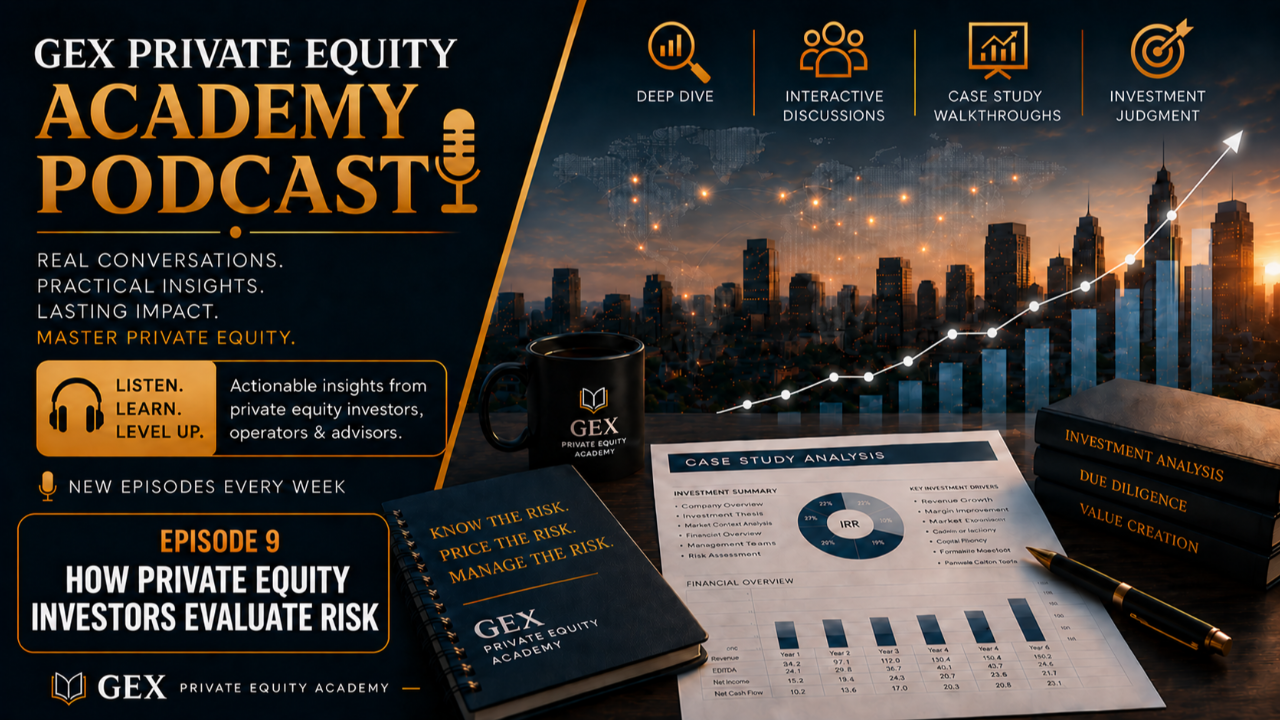
One of the biggest misconceptions about private equity is that successful investors avoid risk. They do not, and they cannot, because every acquisition, every business, every industry and every investment thesis carries risk of some kind. The investors who consistently do well are not the ones who find a risk-free deal. They are the ones who understand the risks in front of them better than anyone else at the table.
The objective is not to eliminate risk. The objective is to understand it, price it appropriately, and manage it after the acquisition, and that distinction shapes almost every decision we make when we evaluate an opportunity.
The First Question: What Could Go Wrong?
When our investment team looks at a new opportunity, one of the first questions we ask is simply what could go wrong. It can sound pessimistic, but I think it is one of the most important disciplines in investing. Most people naturally gravitate toward the upside, meaning revenue growth, new customers, margin improvement, geographic expansion and add-on acquisitions, and those opportunities certainly matter. Experienced investors, however, spend just as much time on the downside, asking which assumptions have to be true, what risks exist, how severe they are, how likely they are to occur and, most importantly, whether they can be mitigated.
That last question matters because risk is not an abstraction that sits beside the return. It has a direct impact on it, and a risk you have not identified is a risk you have not priced.
Five Categories Every Investor Evaluates
No single checklist covers every deal, but in the lower middle market most of the risk we evaluate falls into five categories.
Customer risk. How diversified is the customer base, what percentage of revenue comes from the largest customer, and how stable are those relationships? Could a major customer leave? Customer concentration is one of the most common risks we encounter, which is why I covered it at length in How Private Equity Investors Evaluate Customer Concentration Risk.
Industry risk. Is the industry growing, declining or being disrupted? How competitive is the market, are new competitors entering, and are customer preferences changing? A great business operating in a declining industry can be a very different investment than an average business operating in a growing one.
Management risk. How dependent is the business on its founder, is there real leadership depth, and can the team execute the value creation plan as the organization scales? People ultimately determine whether an investment thesis succeeds or fails, so this is where we spend a significant amount of our time.
Operational risk. Are systems scalable and processes documented, or does the business depend on a handful of key employees? Many companies perform well despite operational inefficiencies, and part of the job is deciding whether those inefficiencies are manageable improvement opportunities or significant risks.
Financial risk. How stable are earnings, how predictable is cash flow, how much leverage will the business carry after closing, and how sensitive is performance to a change in revenue? The answers tell us how resilient the business is likely to be across different economic conditions.
Risk Is Not Always Something to Avoid
One thing I often remind our associates is that risk is not automatically a reason to walk away. In many cases, risk is exactly where the opportunity comes from. If every investor viewed a business as completely safe, the purchase price would already reflect that, and there would be very little left to earn.
The real challenge is identifying risks that we understand, risks that can be priced appropriately, risks that can be mitigated, and risks that fit within our investment strategy. A risk that passes all four tests can be a reason to lean in, while the risk nobody has named is usually the one that does the damage.
The "What Would Have To Go Wrong?" Exercise
One exercise I use on nearly every opportunity is what I call the "What Would Have To Go Wrong?" exercise. Imagine that we have completed the acquisition, and then imagine that the investment has significantly underperformed. What happened? Did we lose a major customer? Did margins decline, did growth slow, did management turn over, or did integration challenges arise?
Working backward from a failure that has not happened yet surfaces risks that a forward-looking review tends to miss. It is the same line of questioning that exposed the real risk in a project-based services business we once looked at, with mid-single-digit millions in EBITDA. On the surface the book looked well diversified across many small projects, but on a deeper look a large share of the work flowed through just two relationships – and losing either one would have changed the entire picture. Nothing in the headline numbers pointed there, which is exactly why the question has to be asked.
Not All Risks Deserve Equal Attention
Another lesson is that risks are not created equal. Some have a relatively low probability of occurring, while others may be unlikely but could have catastrophic consequences. Investors have to prioritize: which risks are most likely, which would have the greatest impact, and which can realistically be mitigated. That prioritization is one of the most important parts of investment judgment.
In practice, the risks that deserve the most attention sit where likelihood and impact are both high and mitigation is hard. Those are the ones that belong in the investment committee memo, in the price, and in the value creation plan after closing.
Understanding Risk Better Than Everyone Else
Ultimately, investing is not about predicting the future perfectly, because nobody can do that. It is about making informed decisions with imperfect information. That perspective comes partly from my own seat as CEO of GEX Management – when you run a business day to day, you learn quickly that surprises are guaranteed, and the real question is whether you saw the category of surprise coming.
The investors who consistently perform well know what could happen, they know what matters most, and they structure their investments accordingly. Every investment contains risk. The question is whether you understand it well enough to make an informed decision, and whether your investment thesis accounts for it honestly. In private equity, understanding risk is often exactly what creates the opportunity.
Here is the full discussion from Episode 9:
Prefer audio? Listen on Apple Podcasts or Spotify.
Enjoyed this? Subscribe on YouTube so you do not miss future episodes, case studies, and practical private equity education.
Join the GEX PE Academy Insider List
You will receive our complimentary Private Equity Starter Kit, transaction insights, and invitations to select live private equity case study sessions.
We hate SPAM. We will never sell your information, for any reason.
About the Author