
How Private Equity Investors Evaluate Customer Concentration Risk
Aug 09, 2026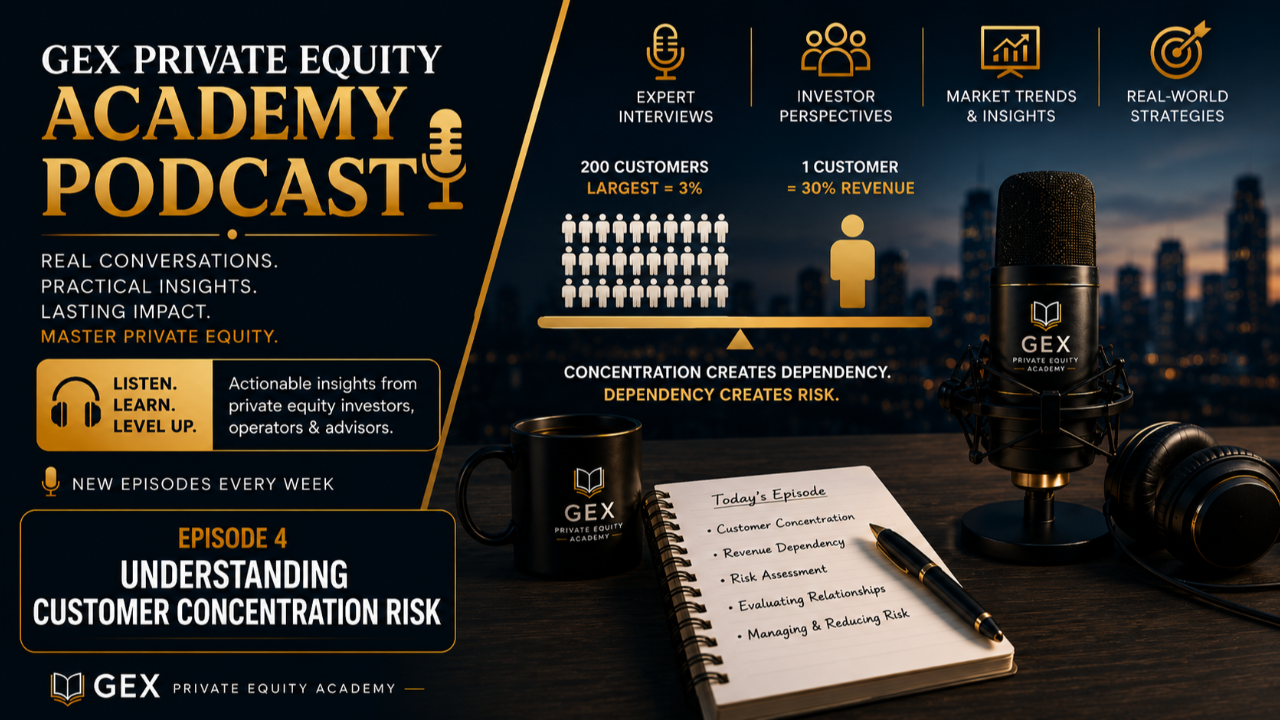
When I review an acquisition opportunity and learn that one customer represents thirty percent of revenue, the percentage itself tells me remarkably little. What I want to understand is which direction the dependency actually runs - and that is a question no concentration table has ever answered for me.
This is one of the more consequential distinctions in lower middle market investing, and it is the one I see missed most often.
The question most people ask backwards
The instinct, when a buyer sees a large customer, is to ask how dependent the company is on that customer. It is the right question, but it is only half of the pair. The other half is how dependent the customer is on the company - and the answer frequently points the opposite way.
A customer representing twenty percent of revenue sounds alarming on a summary page. But if the relationship has run for twenty years, if the company provides a service the customer cannot easily replace, if switching would mean re-qualifying a vendor, re-training staff and absorbing operational risk the customer has no appetite for, then the actual exposure is far lower than the percentage suggests. The dependency runs both ways, and in that configuration it is closer to a moat than a liability.
The inverse is equally true and considerably more dangerous. A customer representing fifteen percent of revenue, won on price eighteen months ago, renewable annually, buying something three other suppliers could deliver by Friday, is a much larger risk than the twenty percent relationship - and nothing in the concentration percentage will tell you that. From my seat operating a company at GEX Management, I have watched both patterns from the inside, and the difference between them is almost never visible in the numbers.
Concentration is rarely a reason to walk away
One thing I tell our associates regularly is that customer concentration is not automatically a deal killer. Almost every business in this market carries concentration somewhere, and a buyer who screens it out categorically will screen out most of the good opportunities along with the bad ones.
The useful questions are narrower than "is this risky." They are whether we can understand the risk, whether we can manage it, and whether we can reduce it after closing. If a business has one customer at thirty percent of revenue, our team works through what diversification would actually require, how quickly it could realistically happen, whether the company would remain profitable if that customer left next year, whether lenders would still support the transaction under that scenario, and whether the investment thesis survives it. Those questions are far more useful than the percentage that prompted them.
Concentration is not only about customers
The other common gap is treating concentration as a customer issue alone. In practice, investors evaluate it across every part of a business where a small number of relationships carry a disproportionate share of enterprise value.
Supplier concentration can be as binding as customer concentration, particularly where a single source controls a component, a license or a territory. Employee concentration - one estimator, one technician, one salesperson holding the knowledge or the relationships - is common in this market and rarely disclosed as a risk. Referral source concentration matters enormously in services businesses, where a handful of intermediaries may drive most of the new work. And management concentration, where the owner personally holds every meaningful relationship, is the version that most often changes what a buyer is willing to pay, because the buyer cannot purchase the owner.
Mapping those dependencies is one of the primary objectives of diligence, and the ones that do not appear on a customer list are usually the ones that matter most.
What concentration does to the price
Two companies producing identical earnings can receive very different purchase price multiples, and diversification is one of the reasons. Investors pay for predictability, they pay for stability, and they pay for lower risk - so a business whose revenue base gives real confidence that future earnings will still be there in year three will generally command a stronger multiple than one that does not.
That is not a penalty imposed on concentrated businesses so much as a premium paid for durable ones. It is also, worth noting, a lever an owner can work on long before a sale is ever contemplated. Diversifying a customer base is slow, unglamorous work, and it is one of the highest-return projects available to an owner who expects to sell eventually.
What I am really asking
Underneath all of it, the exercise is not arithmetic. Investors are not evaluating what a business looks like today - we are evaluating what could happen tomorrow. What happens if a contract is not renewed. What happens if a competitor enters. What happens if industry conditions turn. Good investors spend a great deal of time on those scenarios before committing, because once the acquisition closes, those risks stop being the seller's problem and become yours.
So concentration, in the end, is not really about percentages at all. It is about dependency - how much of it exists, which direction it runs, what would happen if it broke, and whether it can be reduced. Great investments are not built by avoiding every risk. They are built by understanding risk, pricing it appropriately, and managing it after the acquisition.
I would be curious to hear how others handle this one - when you see a large customer in a deal, what is the first thing you look at?
Here is the full discussion from Episode 4:
Prefer audio? Listen on Apple Podcasts or Spotify.
Enjoyed this? Subscribe on YouTube so you do not miss future episodes, case studies, and practical private equity education.
Join the GEX PE Academy Insider List
You will receive our complimentary Private Equity Starter Kit, transaction insights, and invitations to select live private equity case study sessions.
We hate SPAM. We will never sell your information, for any reason.
About the Author