
How to Build a Private Equity Investment Thesis
Aug 21, 2026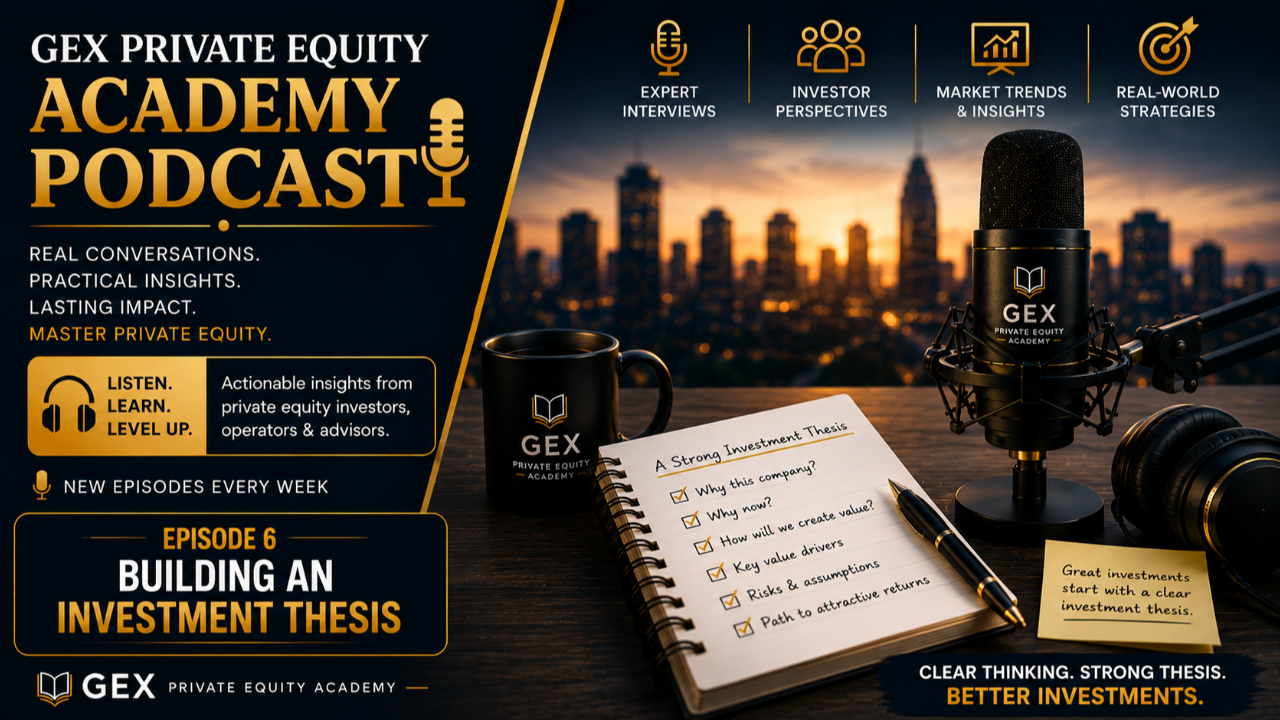
An investment thesis is the answer to one question: why should we invest in this business?
That is the whole thing. It sounds almost too simple to deserve a name, and yet it is where most of the analytical work in private equity actually lives - and where a surprising amount of it quietly goes wrong.
The failure I see most often with newer investors is not a failure of intelligence or effort. It is a category error. They produce a description of a company and believe they have produced a thesis.
A thesis is not a description of the company
"This company operates in a growing industry."
"This company has strong revenue growth."
Both statements might be perfectly true. Neither one is an investment thesis. They are observations - facts about the business as it stands today. A thesis is an argument about the future. It explains why this business, bought at this price, can produce attractive returns over a holding period.
The difference matters because observations do not have to be defended and arguments do. Nobody can disagree with "revenue grew twelve percent last year." Plenty of people can disagree with "revenue can grow twelve percent for four more years because the referral base is underpenetrated and two of the three competitors are undercapitalized." The second statement can be wrong. That is what makes it useful.
When I read a memo and cannot find a sentence that could turn out to be wrong, I know I am reading a description.
The three questions every thesis has to answer
When our team is evaluating an opportunity, we keep coming back to three questions.
Why this company. Not why this industry, and not why businesses of this type generally. What is true about this specific company that makes it worth owning rather than the four others that look similar on a screen?
Why now. Something about the current moment has to make this the right time - a founder ready to transition, a market shifting, a capability the company has built that has not yet been monetized, a price that reflects a temporary problem rather than a permanent one. If the answer to "why now" is "because it is available," that is a process, not a thesis.
How do we create value. What will be different about this business in four years because we owned it, and what specifically are we going to do to make that true?
A strong thesis answers all three. Most weak ones answer the first, gesture at the second, and leave the third as a placeholder.
What a thesis looks like once it is actually built
Suppose we are looking at a home healthcare business.
"The company provides home healthcare services" is a description. It tells you what the business does and nothing about why you would buy it.
Now compare that to something like this: the company operates in an industry supported by demographic trends that are unusually easy to forecast, it has referral relationships that took years to build and would take a new entrant years to replicate, its revenue recurs rather than resetting every quarter, and its operations have never been professionalized in ways that are well understood and repeatable. Geographic expansion is available because the model travels.
That version is longer, and the length is not padding. Each clause is doing work. Each one is a claim that could be tested in diligence and could turn out to be false.
Notice also that no single factor is carrying the argument. This is characteristic of good theses. They combine industry attractiveness, business quality, competitive position, growth opportunity, a value creation plan, and an honest read on risk. A thesis that rests entirely on one factor - a single contract, a single tailwind, a single executive - is not a thesis so much as a bet.
The half that most people skip
Inexperienced investors spend nearly all of their time on the upside. New markets. Additional service lines. Add-on acquisitions. Margin expansion. All of that matters, and it is the enjoyable part of the work.
Experienced investors spend as much time on a different set of questions. What could go wrong. What assumptions have to be true for this to work. What would have to happen for this thesis to fail.
That last question is the most useful one I know, and it is uncomfortable enough that most people skip it. If you cannot describe the specific circumstances under which your thesis breaks, you have not stress-tested it - you have simply not imagined them yet.
The strongest theses I have seen are balanced. They are enthusiastic about the opportunity and unsentimental about the risk, in the same document, without one undercutting the other. No investment is perfect, and a thesis that reads as though this one is has told you something about the author rather than the company.
Value creation belongs inside the thesis, not beside it
Private equity investors are not evaluating what a business is. We are evaluating what it can become, and that is one of the real differences between buying a business and making an investment.
Which means the value creation plan is not an appendix. It is load-bearing. Operational improvements, technology, sales capacity, geographic expansion, new service lines, add-on acquisitions, strengthening the management team - the point is not to list every possibility but to identify the specific initiatives that will increase the value of this business after closing, and to be able to say roughly what each one is worth.
In a lot of transactions the value creation plan ends up being the most important part of the thesis, because it is the part that is genuinely within your control. Whether the industry grows is not up to you. Whether the sales team gets built is.
The two-minute test
Here is the exercise I give our associates.
Imagine you have two minutes in front of an investment committee. Can you clearly answer four questions? Why is the business attractive. Why is the industry attractive. How will value be created. What are the biggest risks.
If you cannot get through those four in two minutes without reaching for the model, the thesis is not finished. That is not a communication problem. Clarity under time pressure is downstream of actually having a view, and the inability to state it briefly is usually the first evidence that the view has not fully formed.
Why two good investors reach opposite conclusions
Something worth sitting with: two experienced investors can review the same business, with the same information, and come to genuinely different answers.
That is not a flaw in the process. Theses are built on judgment. Two investors will weigh the risks differently, see different value creation paths, and hold different views about what the industry looks like in five years. Both can be reasoning well. Only one of them may turn out to be right, and which one is not always knowable in advance.
This is part of what makes the work interesting, and it is also why "a smart person passed on this deal" is not by itself a reason to pass. You have to know what they saw.
What the thesis is really for
The thesis is not a document you produce to get approval and then file away. It shapes everything after it.
It tells diligence where to look, because diligence is fundamentally the process of testing the claims the thesis makes. It informs valuation, because what you are willing to pay follows from what you believe the business can become. It shapes how the transaction is structured. It sets the priorities for the first hundred days.
And it gives you the one thing that is easiest to lose after closing: a way to tell whether the investment is actually working. Without a written thesis, performance gets measured against a budget, and a budget can be met while the reason you bought the company quietly stops being true.
So the next time you look at a business, do not just ask whether it is a good company. Ask why you should invest in it. That question is harder, and it is where every good investment starts.
If you want to go further on what makes a business attractive in the first place, that is the subject of an earlier article - and the judgment side of it, evaluating the people who will actually execute the plan, is covered here.
Here is the full discussion from Episode 6:
Prefer audio? Listen on Apple Podcasts or Spotify.
Enjoyed this? Subscribe on YouTube so you do not miss future episodes, case studies, and practical private equity education.
Join the GEX PE Academy Insider List
You will receive our complimentary Private Equity Starter Kit, transaction insights, and invitations to select live private equity case study sessions.
We hate SPAM. We will never sell your information, for any reason.
About the Author