How Private Equity Investors Evaluate Management Teams
Aug 21, 2026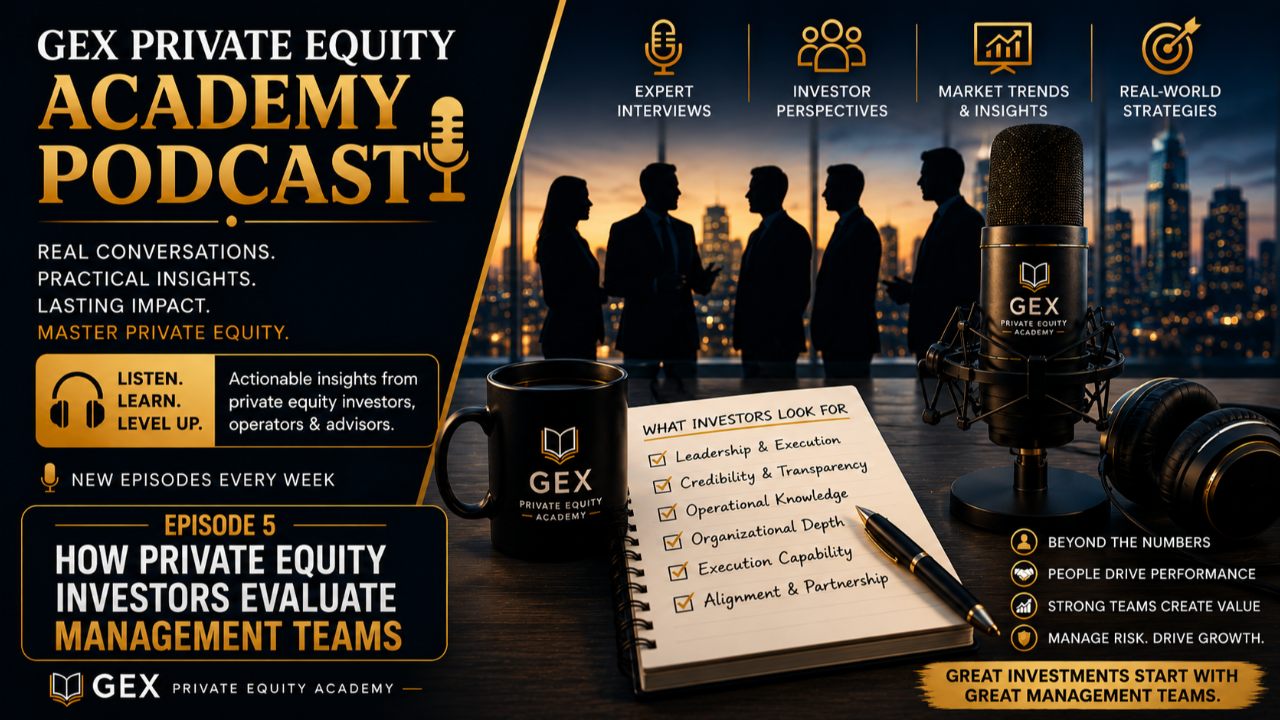
There is a moment in most acquisition processes where the financial model has done everything it can do, and the decision passes to something the model cannot measure. It usually happens in a room, across a table, with the people who actually run the business.
I have watched investors walk into a management meeting genuinely excited about an opportunity and walk out considerably more cautious. I have also watched the opposite - a team so obviously capable that it raised our confidence in a deal the numbers had only made us curious about. Neither outcome had anything to do with the spreadsheet.
The meeting answers a different question than the model
This is the distinction I would most want a new investor to internalise. The financial model tells you whether a business is attractive. The management meeting tells you whether you want to partner with the people running it. Those are two entirely separate questions, and a strong answer to the first does not carry over to the second.
It matters because of the shape of the commitment. Private equity investors typically hold businesses for several years - which means the transaction is not a purchase of financial statements so much as the beginning of a long working relationship with a management team. Trust, communication, alignment and execution all become daily realities after closing, and none of them appear anywhere in a model.
So while the numbers determine whether a deal is worth pursuing, the people determine a great deal about whether it works.
Credibility, and why consistency builds confidence
The first thing I am assessing in a management meeting is not competence - it is credibility. Do management's statements line up with the facts in front of me? Are they transparent about the difficulties? Do they actually understand the business they are describing?
Something I remind our associates before every management presentation is that consistency builds confidence. If the story changes each time a question is asked, investors notice. If management steers away from discussing risk, investors notice that too, and both observations tend to survive long after the meeting ends.
The strongest teams I have sat across from are entirely comfortable discussing weaknesses alongside strengths, because they understand that every business carries challenges and that pretending otherwise is the least credible thing they could do. A management team that names its own problems accurately is usually a management team that can fix them.
Do they actually understand their own business
The next area is operational knowledge, and it separates people faster than almost anything else.
Do they know what genuinely drives revenue, as opposed to what they assume drives it? Do they understand how their customers behave and why those customers stay? Can they name the company's largest risks without being led there? Can they explain their strategy clearly enough that someone outside the industry follows it?
The best management teams hold a deep understanding of both their own business and the market it sits inside, and that depth shows up quickly under questioning. From my own seat operating a company at GEX Management, I would add that this is also the most uncomfortable test to be on the receiving end of - the questions are not difficult, but they are unforgiving of anyone who has been running on assumption rather than evidence.
Can this team execute the thesis you are underwriting
Most acquisitions are built on a growth-oriented thesis. Expand into new geographies. Add service lines. Complete add-on acquisitions. Improve operational efficiency. The opportunity is generally real - that is usually why the business made it this far in the process.
The question that decides the investment is narrower: can this particular management team execute this particular strategy? Identifying an opportunity and delivering it are different capabilities, and an investor who conflates them ends up owning a thesis nobody in the building can carry out.
That is also why the growth case and the management assessment cannot be evaluated separately. A thesis is only as good as the team expected to run it, and a plan that would work beautifully for a different management team is not a plan at all.
The founder question, which sits underneath all of it
Organisational depth deserves its own mention here, particularly in the lower middle market, where many businesses are built around one person. Sometimes the founder makes every significant decision, holds every important customer relationship, approves every meaningful expense and oversees every key employee.
When that pattern appears, the question our investment team reaches for is simple: what happens if the founder steps away? Can the business continue operating well? Can responsibilities actually be delegated, or have they simply never been? Is there a capable team beyond the founder, or an org chart with one real name on it?
The more dependent a business is on a single individual, the greater the investment risk - and this connects directly to something I wrote about earlier in what makes a business attractive to private equity, where management depth sits high on the list of things buyers pay for.
What investors are actually looking for
Strip it back and the list is unglamorous. Investors want management teams that are honest, capable, knowledgeable, adaptable, and committed to building something over a period of years rather than months.
None of that is exotic. It is simply that even excellent investment opportunities require excellent execution, and execution ultimately comes down to people. Financial performance will always matter and always should - but in a great many lower middle market acquisitions, management quality turns out to be one of the single largest factors in whether the investment works.
The model gets you to the meeting. What happens in the meeting is frequently what decides it.
I am always interested in how others weigh this one - when you sit down with a management team for the first time, what is the question you most want answered before you leave the room?
Here is the full discussion from Episode 5:
Prefer audio? Listen on Apple Podcasts or Spotify.
Enjoyed this? Subscribe on YouTube so you do not miss future episodes, case studies, and practical private equity education.
Join the GEX PE Academy Insider List
You will receive our complimentary Private Equity Starter Kit, transaction insights, and invitations to select live private equity case study sessions.
We hate SPAM. We will never sell your information, for any reason.
About the Author